

Table of Contents
Fish oil vs algae oil in 2025 overview: Omega-3 fatty acids are widely recognized as essential nutrients for human health, supporting cardiovascular function, brain development, vision, and inflammatory balance. As awareness of omega-3 benefits has grown, so too has interest in different sources—most notably fish oil and algae oil.
This article examines fish oil and algae oil purely from a scientific and nutritional perspective, drawing on current understanding of omega-3 biology, sustainability science, and human metabolism.
Understanding Omega-3 Fatty Acids: EPA, DHA, and ALA
Omega-3 fatty acids are often discussed as a single nutrient, but they exist in different forms with distinct biological roles and levels of effectiveness in the human body. The health benefits associated with omega-3 intake depend not only on the amount consumed but also on the specific type of omega-3 and how efficiently the body can use it.
- EPA (Eicosapentaenoic Acid)
EPA is primarily involved in regulating inflammation and supporting cardiovascular health. It plays a key role in maintaining healthy triglyceride levels, supporting normal blood flow, and helping balance inflammatory responses in the body. Because chronic inflammation is linked to many long-term health conditions, EPA is often associated with heart health and metabolic support.
- DHA (Docosahexaenoic Acid)
DHA is a critical structural fat and a major component of cell membranes, particularly in the brain, eyes, and nervous system. It is essential for cognitive function, memory, and visual development, and it remains important throughout life to support brain performance and eye health. DHA is especially vital during pregnancy, infancy, and early childhood, when the brain and retina are rapidly developing.
- ALA (Alpha-Linolenic Acid)
ALA is a plant-based omega-3 fatty acid found in foods such as flaxseed, chia seeds, walnuts, and certain vegetable oils. While ALA is considered an essential fatty acid, it must be converted by the body into EPA and DHA to provide similar benefits. However, this conversion process is highly inefficient—typically less than 10%, and often much lower—meaning only a small fraction of ALA is ultimately transformed into the biologically active forms.
Why the Source of Omega-3 Matters?
Both fish oil and algae oil provide preformed EPA and/or DHA, which the body can use directly without relying on conversion. This is why these sources are nutritionally distinct from most plant-based oils that contain only ALA. When the goal is to support heart, brain, or eye health, direct sources of EPA and DHA offer a more reliable and effective option.
Not all omega-3s are the same. Understanding the differences between EPA, DHA, and ALA helps explain why the source and form of omega-3 matter just as much as the total amount consumed.
Fish Oil: Source, Composition, and Absorption
- Origin and Natural Role
Fish oil is derived from oily, cold-water fish such as anchovies, sardines, and mackerel. These fish are not the primary producers of omega-3 fatty acids. Instead, EPA and DHA are synthesized by marine microalgae at the base of the ocean food web. Fish accumulate these omega-3s by consuming algae directly or by feeding on smaller organisms that have already ingested them. Consequently, fish oil functions as a concentrated and biologically effective dietary source of EPA and DHA.
- Omega-3 Composition and Profile
Fish oil naturally provides a combination of EPA and DHA—the two omega-3 forms most strongly associated with cardiovascular, cognitive, visual, and inflammatory health. The exact ratio of EPA to DHA varies depending on fish species, geographic origin, season, and processing methods. In minimally processed fish oils, these fatty acids remain bound in their natural triglyceride structure, which the human digestive system is well adapted to recognize and metabolize.
- Absorption and Bioavailability
From a physiological perspective, omega-3s from fish oil are efficiently absorbed and incorporated into body tissues. The molecular form of the oil plays a critical role in this process. Triglyceride (TG) and re-esterified triglyceride (rTG) forms are generally better absorbed and more consistently utilized than ethyl ester (EE) forms, which require additional metabolic steps before use. Absorption is further enhanced when fish oil is consumed alongside dietary fat.
Scientific Evidence and Clinical Understanding
Fish oil is one of the most extensively studied dietary supplements, with decades of research examining dosage, bioavailability, tissue incorporation, and clinical outcomes. This substantial body of evidence provides clear guidance on effective intake levels and supports its role in heart health, lipid metabolism, brain function, and inflammatory balance.
Fish oil delivers preformed EPA and DHA in a form the body can readily absorb and use, making its source, molecular structure, and method of consumption key factors in determining overall effectiveness.
Algae Oil: Direct-from-Source Omega-3
- Origin and Production
Algae oil is derived from cultivated microalgae grown in carefully controlled, closed environments such as fermentation tanks or photobioreactors. These microalgae are the original producers of omega-3 fatty acids in marine ecosystems. Algae oil bypasses the marine food chain entirely, delivering omega-3s at their primary biological source without involving marine animals.
This controlled production allows for consistency in composition, reduced exposure to environmental contaminants, and the ability to tailor omega-3 profiles through strain selection and processing techniques.
- Omega-3 Composition and Profile
Algae oil formulations are typically DHA-dominant. Some newer products also include EPA, though often at lower concentrations than traditional fish oil. Importantly, algae oil provides preformed DHA—and sometimes EPA—allowing direct biological use without conversion.
Because algae oil does not rely on marine animals, it is free from fish proteins and suitable for individuals seeking non-animal omega-3 sources.
- Absorption and Bioavailability
Clinical studies show that DHA from algae oil is well absorbed, with blood DHA levels comparable to those achieved with fish oil. While EPA absorption data is more limited, research continues to expand as EPA-containing algae oils enter the market. Overall, algae oil is considered an effective source of DHA, particularly for specific dietary groups.
Sustainability of Fish Oil and Algae Oil in 2025
- Fish Oil Sustainability
Fish oil production has improved sustainability through the use of small, fast-reproducing fish species, improved purification technologies, and third-party certifications. However, it still relies on wild fisheries, which remain sensitive to climate change and ecosystem disruption.
- Algae Oil Sustainability
Algae oil avoids fishing entirely and can be produced in closed systems, reducing environmental impact. However, algae cultivation can be energy-intensive, and sustainability depends on efficiency and energy sources. As production technology advances, algae oil is expected to become increasingly competitive.
- Vegan and Ethical Considerations
Fish oil is animal-derived, while algae oil is fully vegan and vegetarian-friendly. For plant-based diets, algae oil provides a rare source of preformed DHA and sometimes EPA. While this distinction is ethical rather than nutritional, it strongly influences consumer choice.
Safety, Purity, and Quality Control
Fish oil requires purification to remove contaminants such as heavy metals and PCBs. Modern distillation is effective, but quality depends on manufacturing standards and third-party testing.
Algae oil is grown in controlled environments, reducing contamination risk, though oxidation control and quality testing remain essential. When properly manufactured, both sources are considered safe and reliable.
Clinical Evidence: Established vs Emerging Research
Fish oil benefits from decades of clinical research across cardiovascular, metabolic, neurological, and inflammatory domains. Algae oil is well supported for DHA-related outcomes but has fewer large-scale EPA-focused studies, reflecting its shorter research history rather than biological limitation.
- Choosing Between Fish Oil and Algae Oil in 2025
For EPA-focused cardiovascular and triglyceride support, fish oil has stronger clinical backing. For DHA-focused brain and eye health, both sources are effective. For vegans and sustainability-driven consumers, algae oil offers a biologically valid alternative.
Conclusion: Fish Oil vs Algae Oil Based on Scientific Evidence
In 2025, fish oil remains the most comprehensively studied source of EPA and DHA, supported by decades of clinical evidence. Algae oil represents an important advancement, particularly for vegan and DHA-specific needs, but does not yet match fish oil in research depth for EPA-driven outcomes.
Both sources are beneficial, but informed decisions should be guided by scientific evidence, health goals, and nutritional requirements, not trends or simplified claims.
Application to MVS Omega-3 – The New Superior Golden Standard Supplement
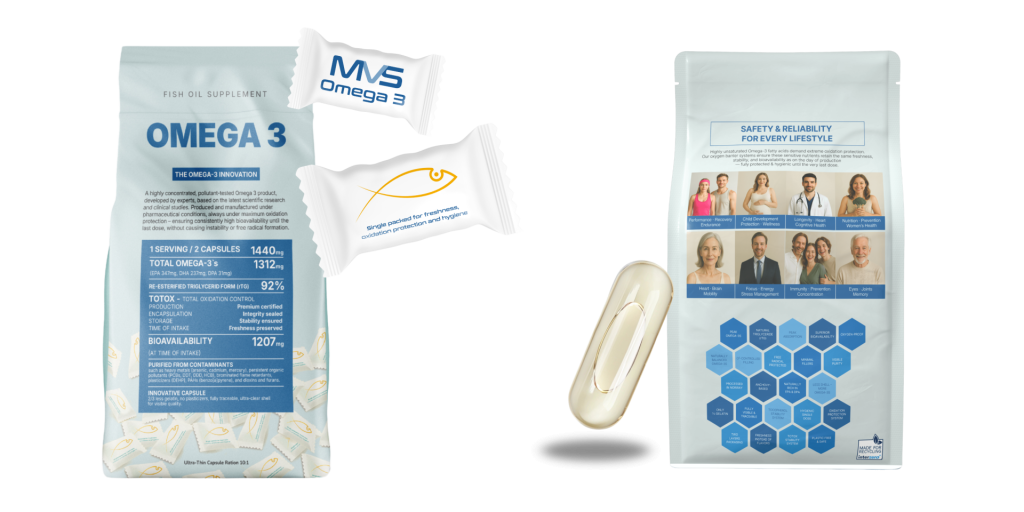
At MVS Pharma GmbH, we integrate cutting-edge research into the formulation of our MVS Omega-3 supplement, ensuring superior bioavailability, oxidation stability, and purity.
1. Bioavailability Optimization
- Recent studies confirm that EPA reaches higher plasma levels faster than DHA, guiding our formulation strategy.
- Instead of ethyl esters, we use rTG form (re-esterified triglycerides), which has higher absorption rates. 92% Re-esterified Triglyceride (rTG) Form — structurally identical to natural fish oil for superior absorption (1207 mg bioavailable) and full physiological compatibility.
- Our marine-derived rTG oil contains 480 mg/g EPA and 320 mg/g DHA, ensuring an optimal balance.
- 90% Purified Omega-3 Concentration — delivering 1440 mg total oil with 1312 mg active Omega-3s (EPA 784 mg, DHA 518 mg) per serving.
2. Oxidation Stability
Omega-3 fatty acids are prone to oxidation, reducing efficacy and even becoming rancid. To combat this:
- We use IP-certified tocopherols as antioxidants.
- Our fish oil undergoes state-of-the-art stabilization techniques.
Oxidation markers:
- Anisidine Value: 4 (Max: 8)
- Peroxide Value: 0.1 meq/kg (Max: 1.2 meq/kg)
- Total Oxidation (TOTOX) Value: Premium production certified + Encapsulation: Integrity sealed Storage: Stability ensured + Time of intake: Freshness preserved. Every stage, from production to consumption, is protected for maximum purity and quality.
3. Pollutant Removal
We ensure stringent purification standards by applying advanced molecular distillation, removing:
- Heavy metals (Arsenic, Cadmium, Lead, Mercury)
- PCBs and dioxins (compliant with TEQ WHO standards)
We source our Omega-3 from sustainable fisheries, guaranteeing the highest purity.
- Scientific Validation
- Our Omega-3 capsules undergo independent laboratory testing, confirming high bioavailability, purity, and safety.
- Research-backed formulation integrates insights from Plasma Levels of EPA and DHA after Ingestion of a Single Dose of EPA and DHA Ethyl Esters (2024).
Conclusion
The study provides essential insights into Omega-3 kinetics, helping us at MVS Pharma GmbH refine our formulations. The rTG form of Omega-3 in our products ensures superior bioavailability compared to ethyl esters (EE).
By focusing on:
- Optimized bioavailability through rTG form
- Superior oxidation stability for enhanced shelf life
- Advanced purification to eliminate pollutants
We provide an industry-leading Omega-3 supplement that maximizes health benefits for our customers.
FAQs
-
What is the difference between fish oil and algae oil?
Fish oil comes from oily fish and provides both EPA and DHA. Algae oil comes from microalgae, is usually DHA-focused, and is suitable for vegans.
-
Is fish oil or algae oil better absorbed?
Both are well absorbed. Fish oil has consistently high bioavailability, while algae oil DHA is absorbed at levels comparable to fish oil.
-
Which is better for EPA and DHA?
Fish oil is better for combined EPA and DHA intake. Algae oil mainly provides DHA, with lower EPA in most formulations.
-
Is algae oil a good vegan alternative to fish oil?
Yes. Algae oil is the best vegan source of preformed DHA and sometimes EPA, without relying on animal products.
-
Which is more sustainable: fish oil or algae oil?
Algae oil has stronger long-term sustainability potential. Fish oil sustainability depends on responsible fishing and sourcing.
-
Should I choose fish oil or algae oil in 2025/2026?
The choice depends on individual health goals, dietary preferences, and nutritional needs. Fish oil and algae oil both provide biologically active omega-3 fatty acids, but differ in EPA and DHA composition, research depth, and source. Selecting between them should be guided by evidence, intended use, and personal considerations rather than generalized recommendations.

